
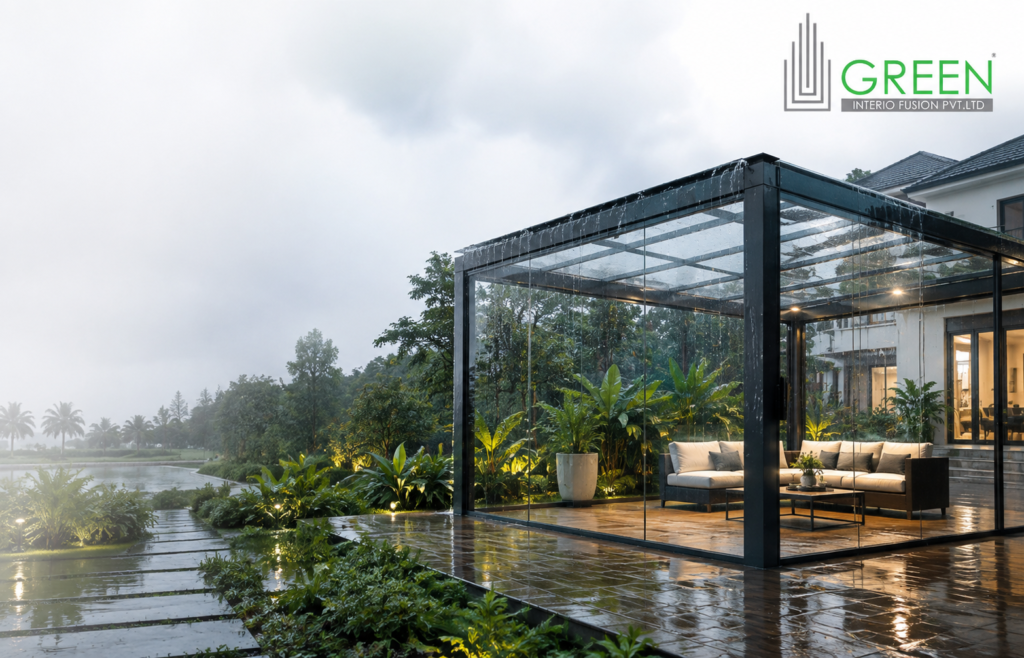
Most of our gazebo enquiries come in the same week the first heavy showers hit — usually right after someone’s open-sided pergola lets water in sideways for the third time. It’s a familiar pattern every June: a homeowner who loved the idea of an open-air seating area in February is suddenly standing in a puddle by July, wondering why the “outdoor room” they built is unusable for four months of the year. A glass gazebo design in Kerala actually needs to handle wind-driven rain, not just a light drizzle from above, and that single requirement changes almost every decision from roof pitch to glass thickness to the way the frame meets the ground.
Why Weatherproof Gazebo Design Matters
The instinct with most outdoor structures is to think about how they look on a dry, sunny day. But a gazebo that only performs in good weather isn’t really doing its job — the whole point of a weatherproof gazebo design is that it extends usable outdoor space through the exact months when you’d otherwise be stuck indoors. For a genuinely monsoon-proof gazebo, we generally push clients toward 10–12mm laminated glass panels for the roof, not the 6mm tempered glass often used in drier states or in structures built without Kerala’s wind-and-rain combination in mind. It costs more upfront, but a thinner panel under sustained monsoon wind load is exactly
where cracks start, and a roof failure on a glass structure is a far more expensive fix than the price difference in glass thickness would have been.
Non-Negotiables for Outdoor Glass Structures in Kerala
A few things we won’t compromise on regardless of budget, because these are the details that separate a gazebo that survives its first monsoon from one that needs repair work by August:
● Roof slope steep enough that water sheets off instead of pooling, since standing water
on any glass roof adds weight and stress exactly where the structure can least afford it
● Sealed aluminium framing with gaskets at every joint, not just the visible ones, because
water finds the smallest untreated gap over a full season of rain
● A drainage channel built into the base, not added later as an afterthought, so water has
somewhere planned to go rather than finding its own way in
● Each of these sounds like a small detail in isolation, but together they’re the difference between a structure that needs to be explained to a client after year one and one that simply keeps working.
Layout Options for a Luxury Villa Gazebo
On layout, we usually land on one of three approaches depending on the plot, the existing landscaping, and how the space will actually be used:
● A frameless minimalist structure for modern villas with pool-facing views, where the goal
is an unobstructed sightline and the glass itself should almost disappear
● A hybrid pergola with a glass canopy for more traditional Kerala homes, blending the
familiar open-beam look with a weatherproof overhead layer
● A fully enclosed courtyard version for a private reading nook, which trades some of the
open-air feel for a space that’s usable in absolutely any weather
None of these is objectively better than the others — the right choice depends on whether the
priority is an uninterrupted view, a nod to traditional design, or year-round usability regardless of
what’s happening outside.
Framing Material
The framing material matters more than people expect too. Wood looks beautiful on day one — warm, natural, and a good match for a Kerala villa’s existing aesthetic. But it warps within a couple of monsoons, and once a wooden frame starts to move, it puts uneven stress on the glass panels it’s holding, which is where secondary problems begin. Powder-coated aluminium doesn’t warp the same way, holds its seal integrity for far longer, and ultimately costs less over the structure’s lifetime even though it isn’t always the first material clients picture.
Why Glass Over Conventional Roofing
There’s a reason clients gravitate toward a glass gazebo design in Kerala rather than a solid tiled or asphalt roof over the same footprint. A solid roof blocks rain completely, but it also blocks the entire experience — the whole appeal of an outdoor structure is being able to sit close to a downpour without being in it, watching monsoon rain move across a garden or pool while staying completely dry underneath. A well-specified glass roof gives you that experience for months of the year that a conventional structure simply shuts out. It’s not just a design
preference; it’s the difference between a room that’s usable four months of the year and one that’s usable twelve.
Maintenance Considerations for a Monsoon-Proof Gazebo
A properly built weatherproof gazebo design isn’t maintenance-free, but it’s low-maintenance if the underlying detailing was done correctly at installation. Gasket seals on aluminium framing should be checked before each monsoon season, since even a well-sealed joint can wear slightly over multiple years of expansion and contraction in Kerala’s heat-to-rain temperature swings. Drainage channels benefit from a quick clear-out before the season starts too, since leaves and debris collecting over the dry months can block a channel that would otherwise work perfectly. None of this is complicated, but skipping it is exactly how a well-built gazebo starts to
show the same problems as a poorly built one, just a few years later.
Choosing the Right Layout for Your Villa
The right layout ultimately depends less on personal taste and more on how the space will actually function day to day. A frameless minimalist structure works best when the view itself — a pool, a garden, a coastline — is the reason for building at all, and any visible framing would compete with that view. A hybrid pergola suits a villa that’s already built around a traditional Kerala aesthetic, where a fully modern glass structure would feel out of place next to sloped tile roofs and wooden detailing elsewhere on the property. A fully enclosed courtyard version makes sense when the priority is year-round usability over an open-air feel — a reading nook or a
private lounge that needs to work identically whether it’s a clear February afternoon or the
middle of a July storm.
Green Interio Fusion has built these across Thrissur, Kochi, and Coimbatore, and the failures we’ve been called to fix almost always trace back to skipped drainage detailing, not the glass itself. A cracked panel is rare; a gazebo that floods at the base because the drainage was never properly planned is common. If you’re planning an outdoor space that needs to work in July as well as December — one that holds up to genuine monsoon conditions rather than just looking good in a photograph — check our structural glazing services or get a free quote for your villa.