
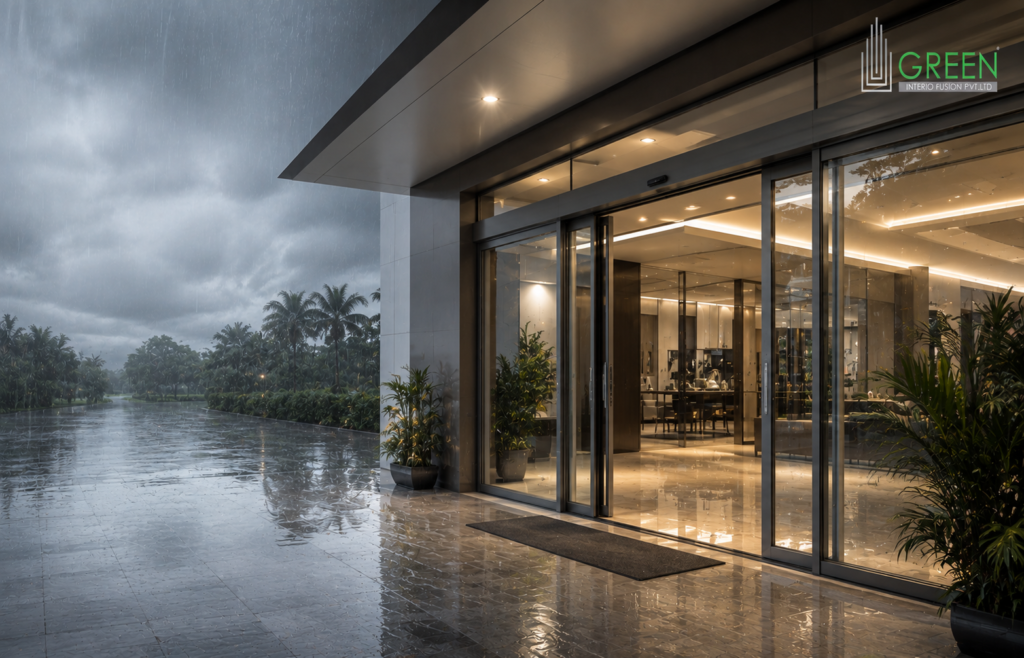
Ask any showroom manager what their biggest monsoon headache is, and most will say the same thing — someone left the front door open for two minutes too long while helping a customer, and now there’s a puddle by the billing counter. It sounds like a small, almost funny complaint until you multiply it by every customer who walks through on a wet day, and it becomes a genuine operational problem wet floors near a billing counter or a showroom entrance are a slip risk, a maintenance headache, and, frankly, not the first impression any business wants to make. Automatic sliding glass doors fix this in a way manual sliding glass doors just can’t, because the fix isn’t about training staff to close the door faster — it’s about removing the human variable entirely.
The Math Behind Sensor Doors
A manual door stays open as long as a person holds it, and during a busy period, that can be a lot longer than anyone intends. A monsoon sensor glass door opens for exactly as long as someone needs to walk through, then closes — no lingering, no forgetting, no depending on whoever is nearest the door to notice it’s still ajar. Over a rainy day with a hundred customers coming and going, that difference between “open until someone remembers” and “open for exactly as long as needed” adds up to a lot less water tracked across the floor, and a lot less time spent mopping between customers.
Where Automatic Sliding Glass Doors in Kerala Matter Most
● Showroom entrance doors Kerala and clinics with continuous foot traffic, where the door is essentially never fully closed for long during business hours.
● Office lobbies, where a wet floor is also a liability risk and not just an inconvenience.
● Villa main entrances, protecting flooring and furniture right by the door from the water that would otherwise track in with every arrival.
In each of these settings, the underlying problem is the same — continuous entry and exit during exactly the weather conditions when moisture control matters most — and an automatic door solves it consistently rather than relying on whoever happens to be closest at the time.
Before Installing
Not every automatic door on the market is built for Kerala-level rain, though, and this is where a lot of installations quietly underperform. Before installing, it’s worth checking that the track sealing is actually rated for water, not just dust — a lot of standard units are designed with dust and general debris in mind, since that’s the more common concern in drier climates, and that’s exactly where the leaks come in later. A door that looks identical to a properly rated one on the showroom floor can behave very differently once it’s been through a full monsoon season.
Beyond the Wet Floor Problem
The water on the floor is the most visible complaint, but it’s not the only reason businesses switch to automatic sliding glass doors before monsoon season. A door that’s constantly being pushed open by hand also lets in gusts of wind-driven rain sideways, which a sensor door minimizes simply by staying closed except when someone is actually passing through. For a showroom with delicate merchandise, electronics, or fabric near the entrance, that difference between constant low-level exposure and controlled, brief openings can matter just as much as the puddle on the floor.
Energy and Comfort Considerations
A door that’s held open longer than necessary doesn’t just let rain in — it lets conditioned air out and humid outside air in, which any showroom or office running air conditioning during monsoon season will notice on both comfort and running costs. Automatic sliding glass doors, by minimizing the time the entrance stays open, indirectly help maintain a more stable indoor environment during exactly the season when humidity control matters most. It’s a secondary benefit that’s easy to overlook when the conversation starts with wet floors, but it adds up over months of daily use.
Matching the Door to the Space
Not every entrance needs the same specification of automatic sliding glass door. A high-traffic showroom entrance door in Kerala benefits from a wider sensor detection range and a faster response time to keep pace with continuous footfall, while a villa main entrance, used far less frequently, can prioritize a tighter seal and quieter operation over speed. Getting this match right at the point of installation avoids the common mistake of installing a residential-grade unit in a commercial setting, where the sealing and duty cycle simply weren’t designed for that volume of use.
Sensor Sensitivity and False Triggers
One practical concern with any monsoon sensor glass door is false triggering — a sensor that’s overly sensitive can open in response to heavy rain or wind alone, rather than an approaching person, which defeats the entire purpose of installing one. Getting sensor calibration right at installation, so the door responds to actual foot traffic without being fooled by driving rain against the entrance, is a detail that’s easy to overlook but directly affects how much water control the door actually delivers once monsoon conditions set in. It’s a small adjustment during commissioning, but skipping it can leave a business with a door that opens itself throughout a storm, undoing much of the benefit the installation was meant to provide in the first place. It’s worth asking about this specifically during installation rather than assuming it’s been handled, since it’s not always something a general contractor thinks to test under actual rain conditions before handover.
We’ve fitted weatherproof glass doors across homes, clinics, and retail spaces in Thrissur, Kochi, and Coimbatore, and the difference between a good installation and an average one almost always comes down to sill drainage — a detail nobody notices until the first heavy rain tests it, and by then it’s a repair job instead of a design decision.
Check our glass and aluminium solutions or get a free site visit before the next spell hits, so the door you install this season is one you’re not troubleshooting by the next one.