
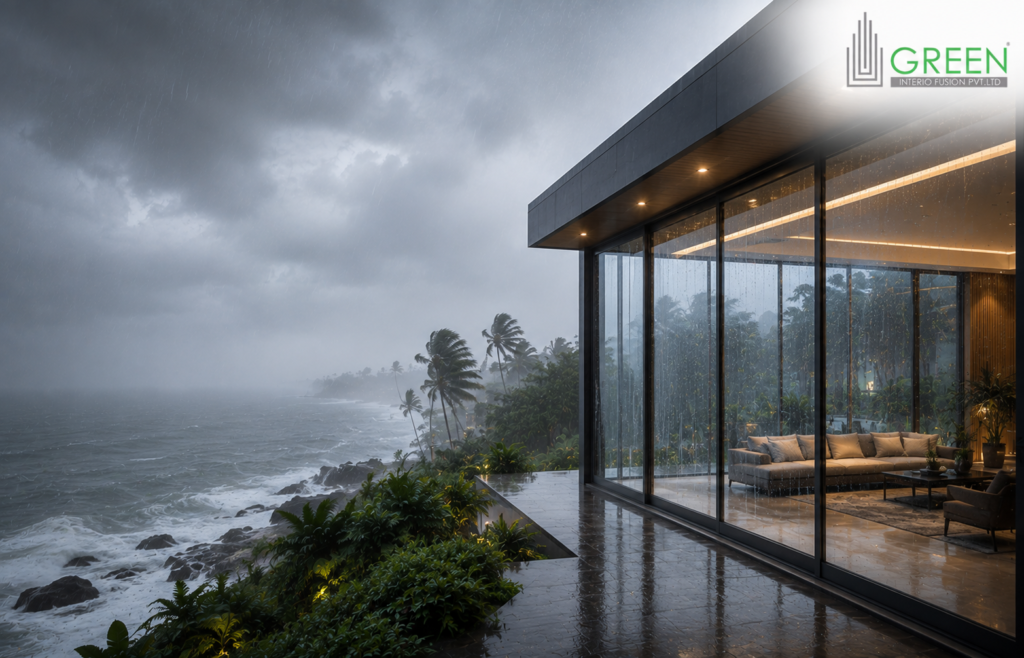
Coastal stretches near Kochi and open plains around Coimbatore see monsoon gusts that standard annealed glass just isn’t built for. It’s a distinction that’s easy to overlook on paper — glass is glass, until it isn’t — but the difference between ordinary annealed glass and a properly specified laminated panel becomes very obvious the first time a structure faces real storm-force wind. Laminated glass for high-wind zones is how we handle that — two or more glass layers bonded with a PVB interlayer, so the panel holds together under impact instead of shattering outward the way a single sheet of glass would.
Why the Interlayer Matters
The interlayer is really the whole point of laminated glass Kerala installations, and it’s worth understanding why it changes the failure behaviour so completely. Standard glass fails suddenly and dangerously — full shards, no warning, and no controlled way for anyone nearby to react in time. Laminated glass installation, by contrast, can crack on the surface and still stay held together in the frame, which buys time before it needs replacing instead of creating an immediate hazard the moment something goes wrong. That difference between an instant failure and a gradual, contained one is exactly why laminated glass is the standard we recommend anywhere wind exposure is a genuine concern rather than a minor consideration.
Where We Won’t Spec Anything Less
A few places where we won’t spec anything less than a fully laminated system, regardless of what the initial budget conversation looks like:
Coastal villas and resorts taking direct sea wind, where the combination of salt air and sustained gusts is more demanding than an inland site of the same general size
- Skylights and overhead glazing, where a falling panel is a real safety issue rather than just a cosmetic one, since anything overhead has to account for what happens if it fails
- High-rise facades, since wind speed climbs fast with every additional floor, and a specification that’s adequate at ground level can be genuinely inadequate a few storeys up
These aren’t arbitrary rules — they reflect the places where a glass failure has the most serious consequences, and where the cost of over-specifying is small compared to the cost of getting it wrong.
A Common Misconception
One thing clients often assume wrong is that storm-resistant, wind-rated glass means bulkier, heavier-looking frames — the kind of overbuilt look that clashes with a clean architectural style. It doesn’t. The strength in a laminated system comes from the interlayer bonding the glass layers together, not from thicker visible framing, so the finished look is essentially identical to standard glass from a distance. Clients are often surprised, once a laminated coastal glass facade is installed, that it looks no different from what they originally pictured — the performance upgrade is invisible until it’s actually tested by weather.
How Laminated Glass Installation Differs From Standard Glazing
Installing laminated glass isn’t simply a matter of swapping one type of panel for another within an existing frame design. Because laminated panels carry more weight than an equivalent single sheet of annealed glass, the supporting frame, brackets, and fixing points often need to be specified for that additional load from the start. Treating laminated glass installation as a like-for-like swap, without reassessing the frame it sits in, is one of the more common ways a genuinely good glass specification ends up undermined by a frame that wasn’t built to carry it.
Laminated Glass and Long-Term Value
The upfront cost difference between standard annealed glass and a properly specified laminated system is real, and it’s fair for clients to weigh that against budget. But the comparison looks different over a building’s lifetime. A coastal glass facade built with standard glass may need panel replacement after a serious storm event, along with the disruption and cost that comes with emergency glazing work on an occupied building. A laminated system, even when it does sustain surface damage, buys time for a planned, scheduled replacement instead of an emergency one — and in many cases, the interlayer means a cracked panel can remain safely in place for a considerable period before it needs attention at all.
Where Standard Glass Still Makes Sense
None of this means every pane in every building needs to be laminated. Interior partitions, sheltered courtyards, and locations with no meaningful wind exposure are reasonable places to use standard glass, since the added cost of lamination wouldn’t be solving a problem that actually exists there. The judgment call is about matching the glass specification to the real exposure of each specific location on a building, rather than either over-specifying everywhere or under-specifying the areas that genuinely need it.
Wind load isn’t the same everywhere in Kerala. A coastal plot and an elevated inland site need different glass specs entirely, even if they’re only a short drive apart, because exposure, wind funnelling, and salt content all vary by location and elevation. We calculate each high-wind zone glass installation against the actual site conditions rather than a blanket regional number, because a single statewide spec would inevitably over-serve some sites and under-serve others. If your project sits somewhere exposed — coastal, elevated, or simply open to prevailing wind — explore our laminated and structural glass solutions before locking in your glazing plan.
Getting the Specification Conversation Right Early
The most useful thing a client can do before committing to a glazing plan is raise the site’s actual exposure — coastal proximity, elevation, orientation to prevailing wind — early in the design conversation, rather than treating glass specification as a late-stage decision. When wind exposure is factored in from the start, laminated glass Kerala installations can be planned into the frame design and budget from day one, rather than becoming an expensive change order once a generic specification turns out to be inadequate for the actual site. That single conversation, held early enough, is usually the difference between a facade that performs quietly through every monsoon it faces and one that needs a costly correction after its first serious storm.