
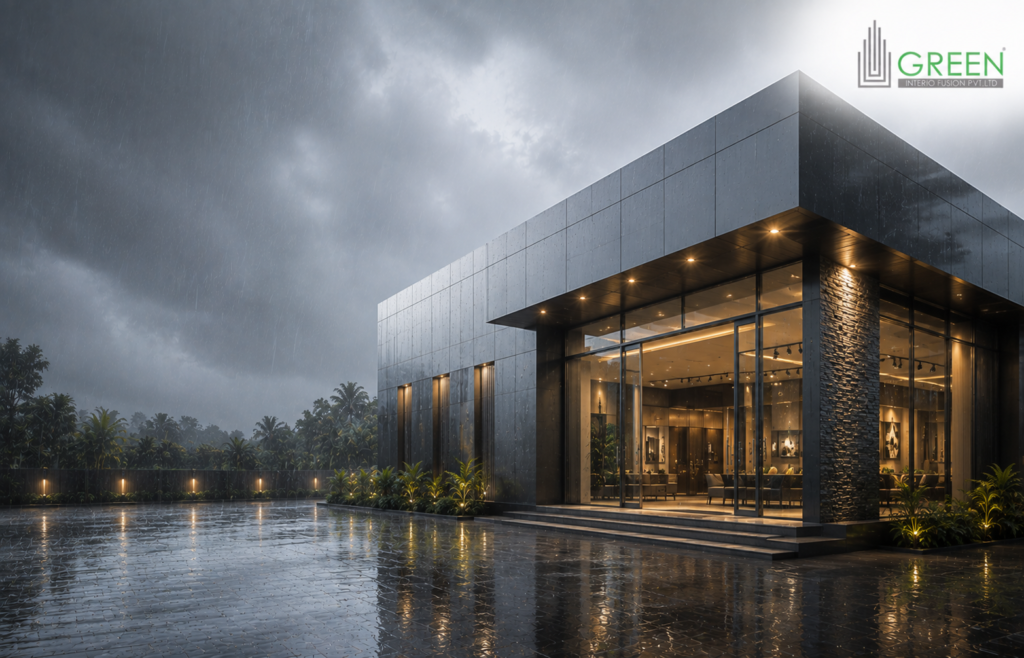
A showroom frontage sells the brand before the customer even walks in — which is exactly why a water stain running down from a badly sealed joint is such a visible problem, and such a damaging one for a business that’s spent real money on its storefront appearance. It’s the kind of defect that customers notice immediately, even if they couldn’t tell you why the frontage looks a bit tired, and it undercuts a brand impression that everything else about the space might be doing right. ACP cladding for showroom frontage work in Kerala exists mainly to prevent that one issue: water finding its way behind a flat facade panel and announcing itself later as a stain nobody can quite explain.
Where Leaks Actually Come From
Most of the leaks we get called out for aren’t actually a panel problem, and that surprises a lot of clients who assume a stained facade means faulty material. They’re a joint-sealing problem or a substructure spacing problem that let moisture sit trapped behind the sheet for months before it shows up as a stain inside — by which point the panel itself is usually still perfectly fine, and the fix is about the installation detail rather than the material. Understanding this distinction atters, because it changes where the actual repair effort needs to go.
Where ACP Cladding Showroom Work Matters Most
- The main frontage, since it’s the first thing customers see and the area where any imperfection is most visible to passing foot traffic.
- Signage backing panels, where water often tracks in unnoticed behind branding elements that aren’t inspected as regularly as the open facade.
- Parapet and roof-edge sections, a spot that gets overlooked constantly because it’s out of sight, even though it’s exposed to as much rain as anywhere else on the building.
Each of these areas has its own reason for being a common failure point, but they share the same underlying cause — water finding an entry point that wasn’t properly sealed or drained at installation.
What Makes the Panel Perform
Aluminium composite panel cladding itself is lightweight, doesn’t corrode, and comes in enough finishes that brand colour isn’t a compromise — a business can match its exact palette without settling for whatever a heavier, more limited material happens to offer. But the panel quality only matters if the installation behind it is done right — correct drainage at the top and bottom edges, and sealant that’s actually rated for constant monsoon exposure rather than general outdoor use, since the two are not the same thing despite sounding similar on a spec sheet.
Why Substructure Spacing Is Often the Real Culprit
When a client calls about a stained facade, the assumption is almost always that the panel has failed somehow. In practice, the substructure — the framework the ACP panels are actually fixed to — is just as often the source of the problem. Incorrect spacing between fixing points can allow panels to flex slightly under wind pressure over time, opening tiny gaps at joints that wouldn’t be visible on a calm day but are enough to let water in during a sustained monsoon spell. Getting substructure spacing right at installation is a detail that has almost nothing to do with the visible finish and everything to do with whether that finish stays intact for years.
Sealant Selection for Monsoon Exposure
Not all sealants marketed for outdoor use are actually suited to Kerala’s specific conditions. General-purpose exterior sealants are often tested and rated for occasional rain exposure, not the sustained, repeated saturation that comes with weeks of continuous monsoon weather. A sealant rated specifically for constant moisture exposure holds its seal integrity through that kind of extended contact in a way a general-purpose product simply isn’t designed to. This is a detail that’s invisible on the day of installation and only becomes apparent — for better or worse — after the facade has been through a full season.
Choosing ACP Cladding for a New or Renovated Frontage
For a business specifying ACP cladding for the first time, or replacing a facade that’s already shown water staining, the priority should be sourcing both the panel and the installation from a team that treats them as one connected system rather than two separate purchases. A high-quality panel installed with poor substructure spacing will fail in the same way a lower-quality panel would, and a well-installed system with the wrong sealant will eventually show the same staining problem regardless of how good the panel itself is. The panel, the substructure, and the sealant all need to be specified together with Kerala’s monsoon conditions in mind from the start.
We’ve handled ACP cladding for showrooms and offices across Thrissur, Kochi, and Coimbatore, and every job is detailed for monsoon performance first and appearance second — though with ACP, you rarely have to choose between the two, since a properly installed system delivers both without trade-off. Explore our ACP cladding services or request a free site assessment before the next heavy spell, so any weak points get caught on a checklist rather than as a stain on your frontage.
A Quick Pre-Monsoon Check for Existing Cladding
For frontages already fitted with ACP cladding, a short visual check before monsoon season is worth the time: looking for any hairline gaps at panel joints, discoloration near the parapet or roof edge, and confirming there’s no visible sagging at fixing points. None of these checks require specialist equipment, and catching an early warning sign before the season starts is far simpler than dealing with an active leak once the rain has already set in. A few minutes of visual inspection each year is a small investment against the cost and disruption of tracing a leak back through an occupied showroom once the damage has already shown up inside, and it’s usually enough to decide whether a section needs a closer professional look before the rain actually arrives. Frontages that go through this simple annual check tend to stay in far better condition over several monsoon cycles than ones that are only inspected once a problem has already become visible from inside the showroom.